
"Analysis and Synthesis"
Another translation of a Musil essaylet from Blei's Great Bestiarum of Modern Literature (1922)

Analysis and Synthesis
Thoughtful people are always analytical. Creative writers are analytical. For every analogy is an inadvertent analysis. And one only comprehends a phenomenon insofar as one recognizes how it occurs or how it is connected, related to, bound to another phenomenon. Naturally, one can just as easily say that every analogy is a synthesis, as is every comprehension. Naturally; they are two halves of the same process.
Nevertheless, today there are many literati who are angry at analysis and who cozy up to synthesis. Their alleged reason is this: if one continually practices partial analysis or partial synthesis (through more thinking) then suddenly everything is connected to everything else, is caused by everything; everything collapses into likenesses and an endless number of combinatory possibilities. Of course that corresponds thoroughly with the truth (and is caused by historical coincidence, which we have to thank for the mode of our internal existence and its categorization into values). But it grows tedious when it is managed like a game, without strong passions or great talent. In these cases, the others rant and rave about the “naked” analysis, the “naked” psychology (although it has nothing to do with psychology, but is more like an ethical experiment), and about an insufficient earnestness when it comes to a value judgments, about sterile rationalism and the like (even though it is not a matter of anything rational, but rather an emotional-rational and senti-mental way of thinking).
—They mistake the naturally egalitarian lack of talent of the representative of the mediocre with the thing itself. They are right to think that an intimacy with internal possibilities does not alone a reality make; but their fear overlooks the fact that making a reality requires a step forwards and not backwards. They know that a person, in order to create an evocative exemplar or a work of art, requires other qualities as well, such as thinking and moral fantasy; but they forget that one must encourage the use of these qualities rather than dissuade the writer from intellectual activity altogether.
To subtly decentralize mankind’s thinking process is certainly not in itself the New Human Being, but it is the only basis from which to create such Beings for someone who has the talent to do so. One is suspicious of nothing more than all wishes for simplification of literature and life, for the Homeric or religious mood, for unity and wholeness.
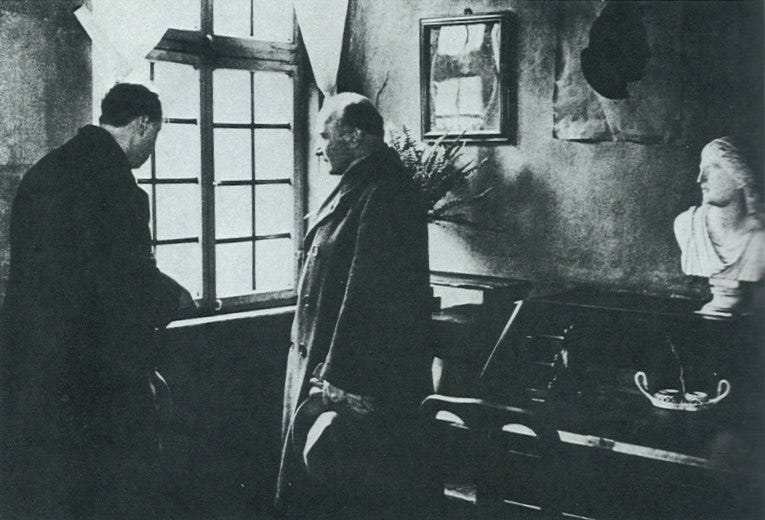
Musil visiting The Goethe House in Frankfurt.