
At Twilight
1899

Musil, on the eve of his 19th birthday, already dreaming about Schwesterlein (little sister) and Bruderlein (little brother).
At Twilight
Finally the day rained itself dead.
In the room it was gray and silent.
It lay as heavy as dust-laden air upon every object.
The brother stared into the rain. He knows that there are rainy days and sunny days; he knows that on rainy days something strangely lascivious rises up from the lifted skirts of women and that on sunny days the people put Springtime on their faces.
He knows that both of these things are lies.
And so he is somewhat disappointed by life and is searching for sensations in something homely.
Now he is listening to the rain.
In a day-long rain there is a suggestive power; one becomes sad and satisfied at once and understands that it can be beautiful to laugh while crying.
His sister sits by the window.
She had read a novel and then was dreaming of something or other. Of her piano teacher—or of a lieutenant at the last horse race—or of the happiness of being the mother of darling babes.
Now she is sad and satisfied at once.
But she doesn’t know why.
But her brother knows.
In her big, gray eyes, he reads a deep, deep fear of these rainy days.
She doesn’t suspect this fear; she is a cheerful child. The dance lesson pleases her and the history of literature and her friend’s newborn.
But he feels that one must hide rainy days from women like this; for something in them trembles and can break in these days of gray in gray—these dead-rainy days.
And so he tells her what she wants to hear. About life. But he stylizes. He speaks of women with sphinx eyes and men filled with goodness and solidity. He speaks with a soft, deep voice, felicitously and musically. His words are so tinted and melodious that they merge with the raindrops splattering on the windowpane. For him, this all has a melancholy irony.
Finally he takes her fine, stretched-out arm and gives her a kiss on the tips of her fingers.
And laughs at himself although he is sad.
Schwesterlein fine—Schwesterlein fine. –
In the room it is gray—and gray—and silent.
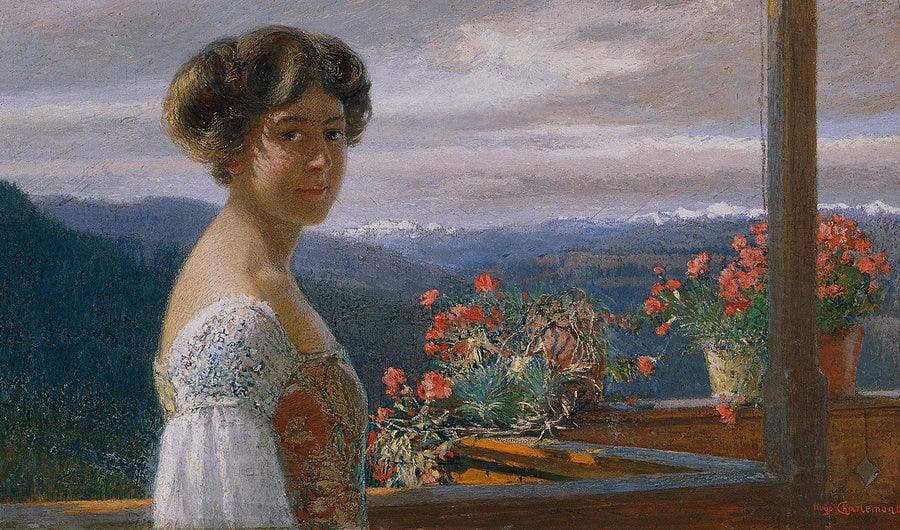
Painting of Alice Charlemont (model for Clarisse in The Man Without Qualities), painted by her father, Hugo Charlemont. Musil sometimes called her “Schwesterlein”.
Fantastic Genese! Beautiful and apropos our reading