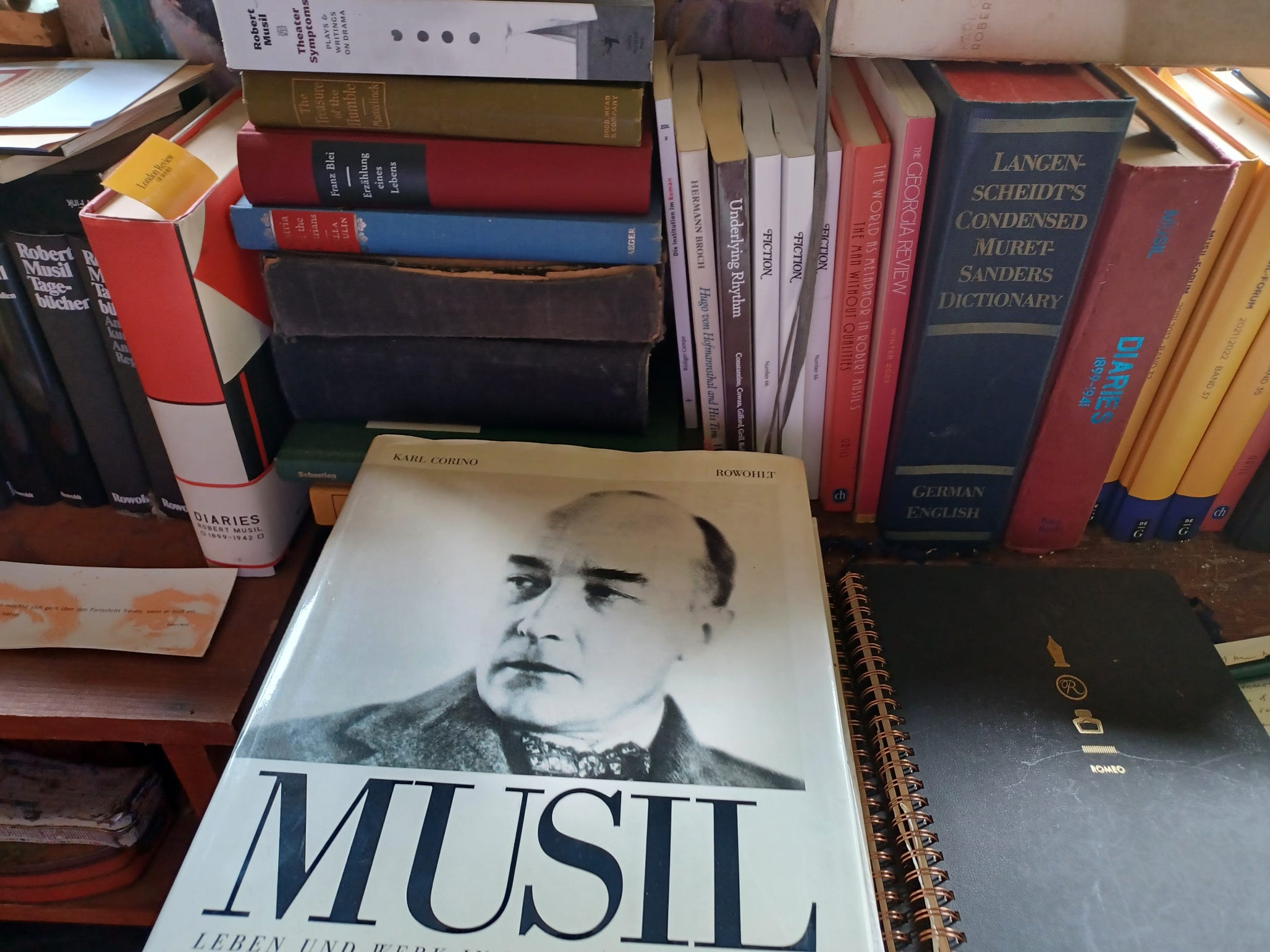

Happy Robert Musil’s Birthday!
This chapter from The Man Without Qualities, Book 1, translated by Sophie WiIkins and Burton Pike, is an introduction to Ulrich’s, the man without qualities’, friends Walter and Clarisse. As is well known, these characters are very closely based on Musil’s own friends, Gustav (Gustl) Donath and Alice Charlemont. He knew Gustl since he was a boy, living beside him in Brno/Brünn for years and later for a time beside him and Alice in Vienna. Like almost all of Musil’s frienships with other men, his friendship with Walter was competitive and intense, rather than warm and supportive. But the friendship, and its constellation of elected affinities and individuation was important enough for him that he once considered that the novel that came to be The Man Without Qualities should be called The Story of Three People, with the added spice of Alice as the third electron. Musil was fascinated with triads and threesomes and said somewhere that love could not exist between two people alone, but always requires the influence of a third, as other, rival, or outsider.
On June 13th, 1905, Musil wrote to Gustl, “Haven’t you noticed that we used to believe we had immoderate talents and now hardly believe any more that we have moderate ones? Where did they go?” When they were young—barely a few short years hence—they may not have really had the talents yet, but they “knew their perfume” and intimated how they might develop them. He quotes a poem by Alice about waiting behind golden gates to hear the approaching footsteps of the “other”—as each brings each something from his or her own garden. And then, the suggestive question: “Shall we not try again to bring loneliness and discourse into proportion?” And then—was he suggesting a romantic ménage à trois like the one tried by Emma Rudolf, Alfred Polgar, and Henry Skene , or the one abandoned by Nietzsche, Paul Ree and Lou Andreas Salome? —he asks: “Isn’t it wise (in the rose-wreathed sense of the word) to develop all of the possibilities of such relationships? Can’t Alice bring you something from me, too? And you something from me for her? Isn’t it almost the only daringly fine thing, to touch one another sometimes only through the medium of a third person?”
Other biographical traces are unavoidable. When the narrator speaks of Walter’s playing of Wagner as a “secret vice,” it is hard not to think of Musil’s notebooks, wherein he recalls how Walter initiated him into the “most universal school secret” of masturbation. It is only on this, my most recent rereading of the book that I notice something else relevant to Musil’s biography: Ulrich’s jealousy of his friends’ piano playing, of the way it has taken over their life—a trope that recurs in a Nachlass fragment wherein Ulrich is so jealous of Agathe’s playing the piano that he shoots a hole in it—probably is a reflex of his jealousy about his mother, who was not only a pianist, but whose extra-marital affair with the man they called “the house friend” drove him crazy.
There is an alternate scene of Ulrich and Clarisse in the garden, listening to Walter play the piano inside, wherein Ulrich and Clarisse have become lovers. And there is, as well, a scence in which Ulrich goes to the “Island” as lovers with Clarisse instead of Agathe, wherein Clarisse’s madness infects him (an incredible scene I already recorded for this birthday episode, but it got lost….another time then).