
Conscious Essayism
An Other Kind of Relating

Last night in our Musil reading group a number of people said that they did not emotionally relate to the characters in the book. A few of us said that we very much did. Of course it raises the question of ways of relating (emotional, intellectual, etc.), but also of individual approaches & experiences of literature. Musil wanted the reader to be shattered in some way, to feel and think in new ways because of the EXPERIENCE of the book (not just intellectually). One could say, by undergoing the ordeal of the book in some moments, but also experiencing its charm and humor.
I’m curious what you, readers, feel about the characters in the book. Do you relate to them, care about them?
Brad Freeman asked who was Musil’s audience—something I had never really thought about. It made me think of something Musil said after the publication of one of the book’s volumes: “If this book succeeds, it will have been wrong,” which seemed to suggest that there was no audience for it… which then made me think that his goal was in a way to CREATE an audience with the book, to inspire the different kinds of thinking that he felt were required to create what he calls “a new morality,” and a new way of being in the world. And not that there had not been others before him who thought and felt like this (the essayists, the experimentors, certain mystics, certain writers, certain non-systematic philosophers, certain scientists, artists), but that this hybrid mode of thinking was very rare, maligned, minimized, made to seem frivolous. This devaluation led to an under-cultivation of the parts of human potential that could have been (still could) bulwarks against barbarism on the one hand, and hollow, superficial life on the other.
We were talking about Musil’s idea of a Utopia of Essayism and Utopia of Exact Living, which, were they lived out in real life would presumably be steps toward reconciling the real world with the world of ideas (which were and currently still are mired in cognitive dissonance, hypocrisy, moral posing and supposing).
Living with Precision would possibly mean “that a life’s work could be reduced to three poems or three actions or treatises . . . in which the individual’s capacity for achievement is intensified to its highest degree…keeping silent when one has nothing to say, doing only the necessary when one has nothing special to do, and, most important, remaining indifferent unless one has the ineffable sense of spreading one’s arms wide, borne aloft on a wave of creation….” “In short, from every ton of morality a milligram of an essence would be left over, a millionth part of which is enough to yield an enchanting joy.”
“The logical outcome of this would be a human being full of the paradoxical interplay of exactitude and indefiniteness. He is incorruptibly, deliberately cold, as required by the temperament of precision; but beyond this quality, everything else in him is indefinite. The stable internal conditions guaranteed by a system of morality have little value for a man whose imagination is geared to change. Ultimately, when the demand for the greatest and most exact fulfillment is transferred from the intellectual realm to that of the passions, it becomes evident . . . that the passions disappear and that in their place arises something like a primordial fire of goodness.”
He then goes on to say that this man of precision already exists: in those separated moments when someone carries out their profession. But not in their lives! If he were asked to take himself and “everything else seriously and without bias” there is no doubt that he “would regard the utopia of himself as an immoral experiment on a person engaged in serious business. Which is why Ulrich, in his concerns with the question of . . . whether a goal or a meaning can be found for what is happening and has happened to us—had always, all his life, been quite alone.”
Musil, too.
I, too.
You?
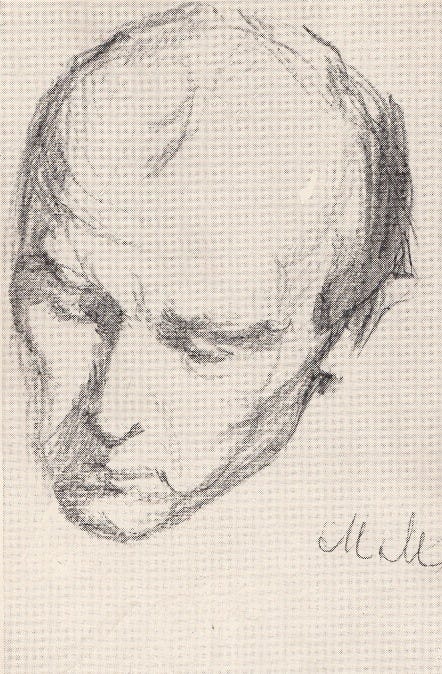
Musil is my all-time favourite writer - I always imagine him in a dicky bow, with a mechanical pencil in his pocket. So deeply inspired by his TMWQ, I bought brass pens (extra-fine nibs) and mechanical pencils that resemble precision instruments.
Yes thanks for your post about Musil’s sense of what he imagined of his reading audience. I had in mind, the psychological aspect of the question. I think you draw my attention to his moral aspiration to arrive with other at the other condition. Or at least lay a pathway to it. “Change your life” is such a grand call. Wonderful inspiring but I feel like the extravaganza of the parallel campaign, could find itself empty instead of full.
I am still trying to understand why Musil is called to write as he does. What personal matters, for lack of a better language, drive him to seek our reading. In short, perhaps, this is to ask whose love he is seeking, maybe whose forgiveness, or whose punishment?
I have in mind something like Hillman’s idea of “the souls code”. That quality we are dealt, like a hand of cards, or corner of dna, that requires a particular kind of life, an imminent purpose.
But I am still struggling to understand Musil’s business of “specificity” as the domain of art and generality as the domain of science. It’s as if he wants to find the universe in a grain of sand.
My partner finds him to be contemptuous of his characters. Finds Ulrich arrogant and demeaning of the women he is involved with. As if Musils fictional alter ego is an egotist. But I find, I am almost more warmly disposed to the ridiculous General Stum, than I am to Ulrich.
So that as usual, and what I love about reading TMWQ is how he makes me think further, grasp at the ineffable, a little more firmly.
Apologies for the length of this comm. It clearly belongs in Stum’s ledger of ideas😊.