
Musil's Gallbladder Operation and his Convalescence in the Harz Mountains

Since I’m hanging around at the hospital these days—alas, not as picturesque as the spa Musil where Musil was convalescing—supporting my dear one through gallbladder troubles, I thought to share some of Musil’s trials with the same organ (the one that processes bile!)
A short excerpt from the biography draft:
The difficulties were mounting on one side, while the pages, covered with revisions, arrows, sentences surrounded by boxes for emphasis, cross-references, and deletions were proliferating on the other: the gigantic long novel against Musil’s neurotic response to Döblin’s joke and then the worsening of his gallbladder troubles. It’s unclear whether the trouble was already acute in Vienna or if the situation worsened while in Karlsbad and Bad Harzburg, but the Viennese paper, The Hour, reported on June 16th that Robert Musil had become very ill on a visit to Berlin and had to be checked in to the Sanatorium des Westen (Joachimsthalerstr., near the Kurfurstendamm) for a dangerous gallbladder operation. There is some uncertainty about the actual date of the operation, but it seems that Musil had his gallbladder removed on June 2nd. Annina’s husband, Otto, a doctor, acknowledged that “The slow progress” Musil was making on his novel “certainly had psychological causes. But one must not underestimate the real: the eternal battle for money and his gallbladder disease.”
From July 8th to the 28th, Robert was convalescing a bit like Mann’s Hans Castorp at the Palast-Hotel Kaiserhof, a sanatorium on the northern edge of the German Harz Mountains, where the Romantic surroundings of half-timber houses and mountain streams inspired a prose piece, part hymn to the Eichendorff poem, “Who Made You, Beautiful Forest,” set to music by Felix Mendelsohn, part self-mockery. The rapturous laudation of the refreshing rejuvenation of the forest can only be fully understood, Musil quipped, if one has just almost died:
Then one reclines—after a terrible misadventure, operated on many times, but once again whole—recovering in the lovely sanatorium of a spa town, wrapped in white towels and blankets, on a breezy balcony; the world is a far-off drone…. One’s memory is still full of fever and the left-over sweet post-anesthesia thirst. And one reminds oneself humbly that in the days and nights when death and life fought each other and the deepest or at least final thoughts would have been fitting, one thought of nothing else but this one thing over and other again: how on a walking tour in high summer one approaches the edge of a wood. Over and over again one’s fantasy plunges from out of the bilious blaze of the sun into the moist darkness ...
One promises one’s self that from now on one will live a life as pedestrian, as mediocre as possible, eschewing everything ingenious, revolutionary, uncommon, even paintings, novels, philosophy. “But the convalescence advances and with it the evil spirit returns,” leading Musil to see the beautiful forest first as an object lesson in violent imperialism (as one tree species pushes out another) and then as raw material for the lumber and paper industry. When he grows nostalgic for his nostalgia, the doctor consoles him: “Criticize as much as you want; a bad mood is a sign of convalescing.”
In a letter to his friend and supporter, the writer and translator, Walter Petry, on July 14th he apologized for not getting in touch in Berlin, but explained that “things went rapidly downhill” with “life”—now, however, “everything is in ascending order.” By the 25th, he was well enough to visit Laurin in Prague—inaugurating a flurry of publications (he sent 7 pieces in August alone) in the Prague Press. Perhaps it was all too much, for he was back in Karlsbad from August 25th through September. In late December, they were in Berlin again, living at Kaiser-Allee 222, in the Pension Rinkel.
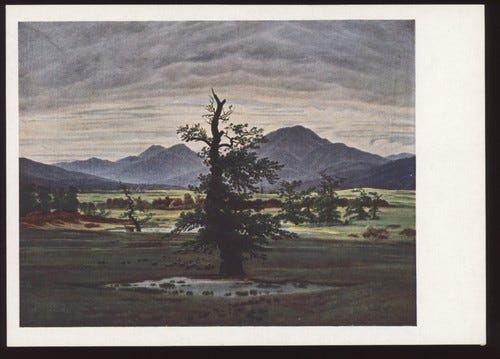
Casper David Friedrich, Harz Mountains