
"Other Human Beings"
Ethical-aesthetical-spiritual-sensualists

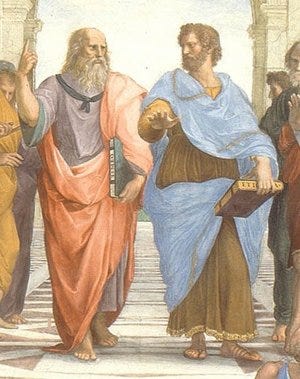
Over the course of writing this biography I have been reminded again and again of an idea that has flitted across my mind for decades now and which was a large impetus for my book about the false dichotomy between spirit and matter (Portals). At one point I was keeping a list of thinkers who defied the simplistic split between Plato and Aristotle, between an emphasis on the abstract and ethereal and the particular and the material. Mystical Materialists. It included Blake, Novalis, Nietzsche, Emerson and Thoreau, Goethe and the other Nature Philosophers, Musil, of course, and more. I even once co-taught a course with my esteemed colleague Dharman Rice at the now defunct Burlington College in Transcendentalism AND Existentialism that dared to entertain the idea that the so-called Transcendentalists—champions of Essence and transcendence—and the Existentialists—champions of existence and particular personal action and choice—had a good deal more in common than at first met the eye. Emerson and Thoreau, for example, learned about the world not only through inspiration and insight into a priori forms, but from a close observance of Nature. Further, while they honored eternal essences, they advocated individual iconoclastic overturning of unexamined moral and social givens. Novalis was a mystic, but studied mining and engineering. Blake, who decried Newton’s limited scientific vision, also celebrated the wonder of the sensual human body. Nietzsche, who often denied the existence of “the thing in itself,” and called all morals and concepts into question, was just as quick to ascribe to modes of knowing others would call irrational and unscientific: instinct, taste, whether or not something made him “fruitful”. The Romantic Nature Philosophers believed in universal recurring forms and truths, but looked for them in particular specimens. They saw the Kantian crisis of subjectivity as an imperative to remake the world. And then there is Musil.
When I first encountered popular views about him (say, on the old Twitter), I was at first surprised to find that some people referred to him as an aesthete who didn’t care about ethical or social issues. That was not my Musil. But then it became clear that this (and so many other) judgment(s) was based on the false dichotomy between ethics and aesthetics and matter and spirit, worldly concerns and art.
Last year I reread Schorske’s famous Fin de Siecle Vienna and found the source of this tendency. The idea was that fin de siecle Vienna had been all about a frivolous aestheticism that irresponsibly turned away from the troubles of the world, which then was redeemed by later artists who were socially engaged. I found that Schorske had got his idea directly from Broch’s book, Hofmannsthal and His Time. which I then read with considerable annoyance because of what I deemed simplistic unexamined premises about art’s alleged distance from life. So many thinkers simply took Broch’s and Schorske’s premises as law, without, I felt, questioning whether the split between art and social questions had really ever been so complete. David Luft was one scholar who seemed to question it or at least qualify it by suggesting the designation of the “generation of 1905,” with Musil as important representative: writers and artists who were searching for a connection between art, irrationality, emotion, and ethics, significance, philosophical questions about how to live the right life in the modern world.
I suppose I am positing the idea that even if there was a particular efflorescence of this non-dichotomous way of thinking around 1905-1930s, there have always been exponents of these “other human beings” in the history of ideas who did not ascribe to the split between the spiritual and the material and the aesthetic and the ethical. But their way of thinking has largely been ignored by scholars and readers because it does not easily fit into categories. Ernst Cassirer and Wilhelm Dilthey, both appreciated by Musil, also belong in this group of “other” thinkers, and are important because they tried to articulate the importance of this realm of aesthetic-humanistic-ethical while other thinkers were busy building up walls between art and ethical life and insisting on a rigid polarization that devalued the aesthetic in favor of so-called justice. I want to bring out this tradition that is being lost between the cracks while the Marxist-infused anti-aesthetic has had such a disproportionate influence on scholarship and even popular transmission of academic ideas. I hope my book is able to bring out this important contribution of Musil, that it opens up a path to appreciate these “other” thinkers and their synthetic confluence.
Here’s a short passage from the biography about “the ethicists, the essayists, and the poets,” who make up a fraternity of “other human beings” for Musil:
Robert wrote: “They are other human beings.” Distinguishing between a moralist and an ethicist was for him early on instinctive. While the moralist “brings a pre-existent and inherited collection of moral premises into logical order,” the ethicist is someone who approaches problems with fresh perspectivism. “I must first demonstrate why I think differently. It come from the fact that I am an engineer. If a mason can’t make a brick fit lengthwise, he attempts to fit it in widthways. A serving maid does the same thing with a stump of wood that she can’t get through the oven door. Even a dog, who tries to bring a stick in his mouth through two obstacles turns his head until he had the right position.” Although humanity seems to have this combination of “unplanned alternation and then planned attempts” in part to thank for its advance, we “frown upon it” in the “realm of justice and morality”.[i]
[i] KA Lesetexte Band 15: Fragmente aus dem Nachlass.Essayistische Fragmente.Das Essaybuch (1923-1927). Versuch einen anderen Menschen zu Finden.
Awesome bit about the moralist / ethicist distinction…
… and 100% unrelatedly, do add an “s” here!!!!!: “It comeS from the fact that I am an engineer.”
Great article! I fully agree with your criticism of Schorske's book. Its insistence on the existence of only purely "aesthetic" artists in fin-de-siècle Vienna always appeared too narrow-minded, as Arthur Schnitzler for example very explicitly mentions social issues in his work (in particular antisemitism).