
The Enchanted House
(A draft translation of the story that turned into "The Temptation of the Quiet Veronika")

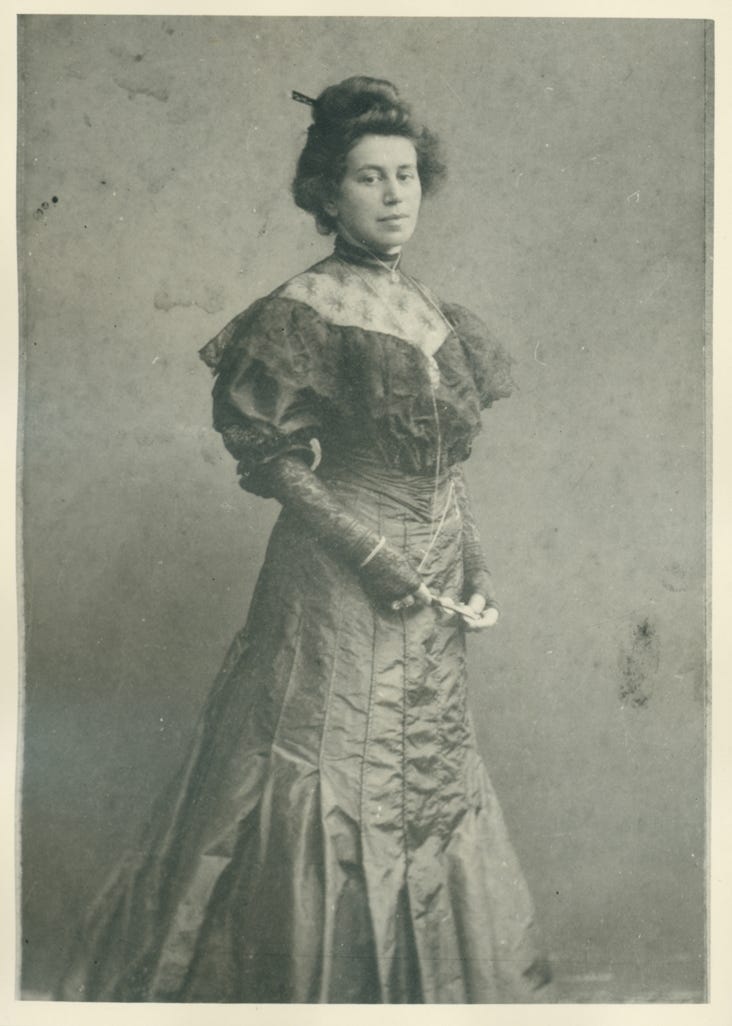
There is so much to say about this story, published in 1908. Musil later reworked it considerably, changing much, adding much, leaving much out, for his story “The Temptation of the Quiet Veronika” for his 1911 Unions book. In both versions we are dealing with a young woman, loosely based on his soon-to-be wife Martha, or at least one side of her—perhaps an alternate version of what she might have become, had her early experiences left her traumatized rather than open, experimental, sensual.
The early version touches upon an illness like the one attributed to Agathe in The Man Without Qualities, which may actually have been influenced by Musil’s own childhood illness. It is lightly suggested that this illness was the traumatic event that Viktoria is repressing; but in the later version, Veronika attributes her inability to fully engage with life to an early sexual experience with a dog.
The language in both versions (as in the other story of Unions, “The Completion of Love”) is very difficult to translate, difficult to read, difficult to understand unless one gives oneself up to its flowing, repetitious imagery and rhythms. Musil was trying to explore the psychic transformations of a woman’s mind (in all three stories), and to radically resist any premature cause and effect conclusions. Much more can be read about all of this in my introduction to Unions.
It would be interesting to compare those sections that are similar in “The Enchanted House” and “The Temptation of the Quiet Veronika.” If someone has my Unions, the comparison could be made by looking at them both side by side, but of course I may have made different translation choices each time. It would require more time and energy than I now have to do a careful comparison and analysis of the originals, but suffice it to say that there are some whole sentences, phrases, and ideas that occur in very similar language in both stories—but so much is different that they really should both be read and experienced on their own—as complements to each other and complements to all of Musil’s work, as they both deal with questions that would continue to haunt him his whole life, especially the question of how one human being may or may not commune with another, the longing and aversion to union, and the permeable sense of self in relationship to a shifting, living world.
The Enchanted House
“She almost poisoned me back then,” First Lieutenant Demeter Nagy repeated every time he told the story of his adventure in the enchanted house. It happened while his battalion was quartered for a few winter weeks in the old town estate of a noble family; and began when, a day before a brief deployment, he overheard—shaking his head because he did not understand it—the end of a conversation carried over to him from the next room by two people’s voices, raised in evident excitement. First there was a No, very quiet but nevertheless separating itself strangely from what came before, carried through the house; then a man said something that he couldn’t quite hear, and from then on he understood every word completely clearly. A deep woman’s voice, that passionately rose and then fell, cried: “Leave me; I can’t! I can’t!” And the words broke off jaggedly, as if from a brittle wall. Then Demeter heard the man speak again: “Just the same, you love me! Your whole being is possessed by mine; it has no thoughts that I am not behind; your life began again only with me. Do not deceive yourself ... That is love; say ... do you love me...?” And the voice of the woman answered more quietly but rose again while she spoke, and broke: “I? oh … perhaps, that is, no . . . no, I don’t know.” And Demeter heard the man speak again: “Listen then, Viktoria, if you refuse to answer I will leave today, and by tomorrow I will have thrown my life away, if you refuse. You know how much I only lived for you in this last year. I know that you love me. Maybe tomorrow you will know it as well. I ask you once more: could you?” –After that there was a short pause and then Demeter heard: “No!” and then again, “No”—twice as if with a whip or like someone mindlessly clutching herself hard—and then, again, “No,” softer, collapsed, and like pain over an injury.
When he didn’t hear anything more, Demeter Nagy whistled half aloud through his teeth, as he had done in difficult situations ever since he was a boy, when this sign of brave cold-bloodedness in Scout and Indian stories had first seemed worth imitating. Then he clicked his heels together, twisted up the edges of his mustache, shook his head once more, and smiled. He felt the way others feel when they suddenly see two souls with bloody entrails devouring each other. For, whether it’s a matter of some last ripping apart or a first flinging together, overhearing shamelessly mindless fighting or the grappling of either a pair of lovers or a dying man: no one knows why, but one doesn’t love being reminded that the most extreme secrets of pain and passion, those moments one senses as the deepest arousals of one’s own being, seem no different to other people than the experiences of someone else; one feels that like an assault, like someone coming too close; one retreats, one involuntarily tries to win back one’s lost equilibrium and instead of feeling empathy, one is driven, by a brutal drive for self-defense, to experience what one has observed as repulsive or ridiculous. Demeter Nagy, too, in the moment after the first surprise, was tempted to find the overheard scene as amusing. But while he quietly packed his things in a small travel bag, he gradually became more and more pensive, and finally stood completely still for a while, filled with astonishment and with the suspense of an animal that has picked up a scent. “Viktoria? How could this girl have done that?” And Demeter reflected.
But again and again he came up against something impersonal about her, something that didn’t allow him to grasp how she could become the central point of a passionate incident. There was something long-ago-flickered-out about her, like the aroma of extinguished candles, something haunted, like those salons that sleep, motionless, under linen slipcovers and behind closed drapes. He couldn’t imagine such a woman in passionate arousal or it would have to be a sort of wispy or windswept passion, a restless tenderness, something that awakens like a ghost following after the beloved’s feet like an abjectly clinging shadow. And even if Demeter knew how to appreciate this taste of overripeness in love, and of an imminent obliteration already present from the beginning of a romance, it seemed to him like a pleasure that one satisfied in secret, like a sickly mood, and he could not imagine how anyone could take it seriously enough to commit suicide over it.
Just the same, he himself sensed—perhaps strengthened by the impression of the whole house itself—something of the unique beauty of Viktoria, something that impelled him to constraint. When he had arrived, he was almost not allowed in. The old woman, Viktoria’s aunt, didn’t want it at all or she would have preferred to have a nobleman, and only when the mayor himself came to ask her and personally gave her his reasons, did she give in; and Demeter was taken into the house, albeit still begrudgingly. His orderly gathered what he needed from an old servant; otherwise he saw no one, and they quartered Demeter in the little-used library that stood beside the foyer; his riding boots stood there on the old glossy parquet floor, between the feet of a little Empire table, behind which a golden grandfather clock softly and ceaselessly swung with a heavy, courtly presence. And some sort of rumbling, a creaking, a feeling like a crudely hammered-in wedge, wouldn’t leave Demeter be since he was in this house. No matter how carefully he walked, the floorboards and stairs groaned in the silent building, and the doors squeaked in his hands. He often scared himself and sometimes even lost his confidence. It wasn’t that he was afraid of disturbing the old woman, who lived far off, in the wing of the house that stood near the garden; and he never saw her; but he often ran across Viktoria. He always had the impression that she had silently appeared before him out of the darkness, and that it closed behind her again, very strangely, without movement. And Demeter sometimes stood still and felt something like shyness and was no longer certain whether his judgment—that he was faced with the silent, powerless wilting of an aging virgin—was at all correct. Indeed, it happened that he felt something like a powerful, unusual sensuality, like a strange sickness, graze by him. Viktoria was tall and had a broad, slightly flat chest; her hair was pulled back tightly above her low, uncurved brow; her mouth was large and lascivious and a light down of black hair covered her arms. When she walked, she held her head inclined, as if her delicate neck could not carry it without bending over, and she jutted her body a little bit forward. There was a peculiar, almost shameless blasé placidity in her way of walking and she looked at the officer in the same soft and gentle way, and thanked him for his greeting, as if it were something very far away.
“…Maybe she’s the secretive type.” With this, Demeter concluded his reflections, a bit annoyed and almost a little intimidated, and closed his travelling bag with a disgruntled snap. — — — In the meantime, Viktoria had accompanied the departing one a stretch of the way. Something opaque, that previously had weighed on her life like a dark fog, had begun to shift; and forms fell away like unfamiliar limbs, as if they were a veil, and disappeared. Things that she had never seen before appeared. Her life, that before was like a narrow, dreary path, suddenly had transformed into the broad grandeur of a garden. Everything that she did happened as if it fell from her like heavy, costly garments; elegant golden chains hung upon her movements—or everything that she did happened as if seen from a broad vista. It was accompanied by that softly resonant understanding that compresses the actions on a stage together, the way a usually invisible pebble-weave path suddenly appears as a sign. But everything was still presentiment. Nothing lifted its face high enough that her fingers could hold it; everything still slipped between her gently fumbling hands. It was just no longer that black, viscous mass that obliterated every form with its obtuse ugliness; instead, it lay more like a very thin, silk mask over the world, bright and silver-gray, and trembling, as if it were about to be torn. And she strained her eyes and it flickered before her, as if she were being jolted by invisible nudging.
This movement had been coming toward her for a long time already. Viktoria wondered whether it might be love. It had come slowly. And yet, for the tempo of her life, it had been fast. The tempo of her life was even slower; it was so slow. It was like a slow opening and closing of the eyes and it glided in between like a glance that can’t hold on to things, and slowly floats by, untouched. She had seen it coming with this glance. So she couldn’t believe that it was love. For she loathed it as darkly as she despised everything foreign; without hate, without sharpness, only like a foreign land, on the other side of the border, where one’s own land flows together with the sky, so softly and inconsolably. Her life had become joyless since she had come to loathe everything foreign like this, to silently retreat from it. Sometimes it seemed to her that she didn’t understand its meaning, but since this man was in it, it seemed to her that she simply had forgotten it; sometimes something tormented her like a memory of an important thing pushed below her consciousness.
There once was a time when she stood closer to life, sensed it more keenly, as if with her hands or on her own body; but she didn’t know anymore how or when that was. For since then a languid everyday life had lain over these impressions and had erased them, the way a dull incessant wind erases the traces in the sand; only its mono-tone could still be heard in her soul, like a softly swelling in and out humming. She knew no more strong pleasures and no strong pain, nothing that would have been distinguishable from the usual, nothing lasting, and gradually her life grew more and more vague to her. The days passed, each like the other, and one like the other came the years; she did feel that each one took some small something away and added something and that she was slowly changing, but never did one thing stand out clearly from any other; she had an unclear, flowing feeling of herself and if she explored her interior life, she found only the change of approximate and veiled forms, incomprehensibly, like when one feels something moving under a blanket without guessing its meaning. It was as if she lived under a soft blanket or under a bell jar made of finely sanded horn that grew more and more transparent. The things retreated more and more and lost their faces, and her feeling about herself, too, sank further and further into the distance. In between was an empty, enormous space and in this space lived her body. It saw the things around it; it smiled; it lived; but everything happened without significance; and often an unyielding disgust crept silently into this world, smearing all her feelings with a mask of tar.
And then he came, he who possessed everything, into the dusking desert of her life. He left, and the things ordered themselves under his eyes. It was as if had inhaled the world and held it in his body and could feel it from inside and then simply and carefully could lay it out before him again, like an artist juggling flying rings; it hurt her how beautiful he was. She was envious of him, because nothing arranged itself beneath her eyes. And her love for these things was like that of a mother for a child, whom she is too small to lead. She tried to lift herself up, but it hurt her, as if her body were sick and could not carry her. And she sunk down slowly into herself again and cowered in her darkness and stared at him and experienced this locking into herself almost like a sensual caress, to which she lasciviously gave her awareness, so close she was to his eyes and yet so unreachable to him. Something bristled in her like soft, rustling cat fur and like a small glittering ball she let her No out of its hiding place, to roll before his feet.
And now it was as if something had been sprung with a soft clicking ring, and as if out of a shell lying broken on the ground, a feeling of herself had risen up; it was suddenly so strong that she felt herself to be a knife in the life of this other person. Everything was clearly delineated; he would go and kill himself; that was something as substantial as a dark, heavy body laying upon the ground; it was as irrevocable as a slice through time, before which everything that had been streaming froze; this moment sprang out of all the other mmoments with a sudden flash like a sword and she saw something quite clearly that one cannot see—how the relationship of her soul to this other soul, in her momentary position, suddenly became a passing-through-thing, a drawing back and a bridge to something final, immovable, inalterable, something that protruded into eternity like a tree branch. A dream-brightness rose up inside her, in which the finest occurrences became as visible as tender veins; a mysterious new light lay upon the things, and she felt it upon herself; she changed herself within it for herself; she was almost only a figure like those that stride through the pictures of sleepers …. She could perhaps believe that this was love; she was already filled with tenderness for him, whom she thanked for all of it…. But she strode through another world, and Viktoria carried a desire to hurt him there like a light wind that she inhaled, quivering as if she were picking up a scent that filled her and lifted her up; and her gestures flew up inside this world and snatched at the distance, where her steps loosened themselves with a soft pressure from the earth and lifted up above the woods. — — —
And Viktoria walked the path back alone, lost in thought. At home she quietly did what she had to do and the day passed as peacefully as all other days. From time to time, what had happened came into her consciousness. She looked at the clock; now he must already have given the boy at the inn his bags so that he could carry them to the train; now he must already have given the conductor his ticket for this last journey. Before her eyes, she saw the small piece of cardboard in the tender hue of a brimstone butterfly. Then she forced herself not to think of him for a long time; and the next time she did, the train must have already rolled through the night of the mountain valleys to the south. She went to bed early and fell asleep right away. But she slept lightly and impatiently, like someone who is expecting something special the following day. Behind her eyelids was a constant brightness; toward morning, the light grew brighter and seemed to spread out—it became unspeakably vast. When Viktoria awoke, she knew: the sea. Now he must already see it before him and had nothing more he needed to do in the world aside from fulfilling his resolution. He would row out and shoot. But Viktoria did not know when. She began to calculate and compare different scenarios. Will he go immediately to the boat from the train…? Will he wait for the evening? When the sea spreads out there so quietly and looks at one as if with big eyes? … She went through the whole day with uneasiness, as if fine needles were pricking her skin. Sometimes his face rose up somewhere—from a golden frame that glittered on the wall, from the darkness of the stairwell, or out of the white linen that she was sewing. Pale and with crimson-red lips … distorted and bloated with water … or just a black curl over a sunken brow. She was still distant from herself, but she walked slowly back in. And when it was evening, she knew that it must have happened.
A deep peace and a feeling of mystery descended upon her from above. She lit all the candles in her room and sat among them, motionless, in the middle of the space; she fetched his picture from her drawer and stood it up before her. The whole chamber seemed to be one single emotion, a soft ringing, like the kind that goes through a house at Christmastime. The furniture sat immovably in its places, the table and the shelf and the clock on the wall; they were completely filled with themselves and as enclosed in themselves as a balled up fist; and yet they looked down on her, as if with open eyes, as if they had waited all the many years that they stood there, only for this evening to find each other. Something shuttered and arched upwards; it streamed down from all sides and lifted itself up… Viktoria had a feeling as if her life stood around her suddenly, like a gigantic space with silent flickering candles. And then it was like the way it is in fairy tales; veils sank down, soft as falling snow, before the illuminated windowpane, and pictures of her life seemed to pass before her, woven together; a scent of childhood rose out of the chests and wardrobes; the lights crackled…
…
Children do not have souls yet. The dead do not have souls either. They are not yet or they are no longer; they can still become everything or were everything. They are like vessels, to which dreams give form; they are blood, with which the wishes of the lonely paint their faces. She felt him very near to her, ever since he was dead; she felt him as close as herself. Since his soul had died, he belonged to her dreams, and her tenderness moved through him without obstacles, like the waves move through those soft, purple bell-shaped vorticellids that float in the sea. She felt no more hate. She had felt this hate as long as he lived; as long as he lived, he was really dead to her. There had been a very soft, pale wish in her that he would be dead. Still like an autumn day that produces no more fruit and waits for nothing more. There was a wildly silent love game, when she let her gaze glide soft as needles into him, deeper and deeper, to see whether, in the trembling of his smile, in a curl of his lip, in some response to the torture, something that autumnally giving would rise to meet her searching love. His hair then became like a forest and his nails like large micaceous plates; she saw moistly flowing clouds in his eyes and small playful pools; he lay there completely defenselessly ugly, with opened borders; but his soul was still enclosed within a final tower. And Viktoria bent more deeply down over him, very close to him; she bent over him and into him, up to the last internal resistance, which no stranger can penetrate; she tried to bend down even further still, into, over this boundary. And she saw with his eyes, like someone who manages to catch a glimpse from a high tower window; she knew that this glimpse would never ever return to her again. It came to her from outside; it struck her like something foreign; she glittered from the gold like a mirror, from the gold, and yet only a mirror, in which his soul looked down at itself from its tower. For the soul that living people have is that which doesn’t let them love that thing in all love that reserves a remnant for itself, that which in all love only sees itself; they can’t give themselves; they always remain themselves; they come with handcuffed hands and closed eyes, to give themselves, and yet they only love the other person because their loneliness softly bleeds behind him or her.
But, as if in a thousand tenderly solicitous folds, an unspeakable happiness nestled itself protectively around Viktoria now; “You are dead,” dreamed her love; she called him by the familiar “du” for the first time and the lights mirrored warmly in her dreams. She sat among them and inside of a blue crystal house, and heard her heart like a small glass clock inside—a clock that called the hours of her life back and to her. She sat with her distaff and spun filaments, weaving them into images; for now he had no soul. But her love lay over him, large and soft like a cat that purrs in tender dreams. The hours flowed by like murmuring water… she lost all sense of time.
When she startled awake, she found her sorrow for the first time. It was cool around her; the candles had burned down and only one still burned; in the place where he had always sat, there was now a hole in the room—and all her thoughts could not fill it. And suddenly, without a sound, this light, too, went out, like a last departing guest quietly closing the door; Viktoria remained in the dark. Humbly wandering sounds moved through the house; the stairs shook the pressure of the walker off themselves with a shy exhalation; somewhere a mouse nibbled; a clock struck. This is how they dole out the hours of my life to me, as if from a large sack, from which they all take, felt Viktoria, and she was afraid again in the midst of this strange expanse of existence. But something like a needle-thin crutch held her and helped her forward. The inextricably interwoven voices of things spoke, audibly, in the night; what was this thing inside her that answered with a far-off and ungraspable, disappearing, soft melody? What was the fine, gnawing blissfulness, despite her sorrow, that hollowed her body out until it bore her softly and tenderly with its thin casing? It called to her to undress. Just for herself, just for the feeling of being near to herself, alone with herself in a dark room. It excited her the way her clothes sank softly crackling to the floor; it was a kind of tenderness that took a few steps into the darkness, as if someone were searching for her, reconsidered, and then rushed back to nestle up against her own body. And as Viktoria slowly picked up her clothes again, with hesitant pleasure, these skirts, whose folds in the darkness, like ponds in dark caves, were still hemmed with her lethargic warmth, billowy spaces rose up around her, somewhat like hiding places in which she knelt; and when her body secretly glanced against their sheathing, a sensuality trembled through her, the way a hidden light moves behind closed shutters, restlessly, through a house.
It was this room; Viktoria felt how occurrences are sometimes strangely alike. Her glance searched for the place where the mirror hung on the wall, and did not find her image; she saw nothing … Perhaps this, too, was a deception. The darkness filled the house like a heavy liquid; she seemed to be nowhere in it; she began to walk; everywhere was only darkness; nowhere she; and yet she felt nothing besides herself and where she went was and was not something, like unspoken words sometimes in a silence. Once she had seen angels in this room, when she lay sick; they stood around her bed and from their wings, without them having to move, came a thin, high sound that cut through the things. The things fell like dumb stones; the whole world lay in sharp, broken shards before her; and only she pulled herself together; consumed by fever, abraded thin like a wilting rose petal, she had become transparent for her feelings; she sensed her body from everywhere at once and also as very small, as if she held it clasped within her hand. For the others, she seemed no longer to be there; like a glimmering lattice through which one can only see out, and a humming sound on the other side.
There was something of this sickness in the sensuality she felt in herself; she avoided the objects, carefully pulling back, but felt them already from a distance; in her was that hushed streaming and sinking down, before which everything external is hard and far off and behind which everything is soft as if behind silent collapsing silk drapes. Gradually it grew gray and mild with snow light in the house. She stood upstairs at the window; morning came; the people came to market. Here and there a word flew up to her; she leant back into the gloaming as if she wanted to avoid it. She felt this movement the way one lets something glide through one’s hands that one had kept in a chest for years. For this was how she stood as a young girl; and while she looked down, a crackling resistance surrounded her, as if fine shards of glass would break off if her glance came too close to a person. And she stood here later, back then, when she arranged her hair in fantastic styles in the night and when she gave her fingers—which she washed with fragrant water after touching the hands of another person—the names of fairytale lovers, who all were herself. She always stood here when no one loved her and when she was afraid of people, because her love was as defenselessly soft as a dark naked snail who searched with a vague tremor for another who longed for her to cling to its body, broken open and dying.
And slowly something surrounded Viktoria; it was a longing inside her, as aimless and still as the sore uncertain tug in her lap before the returning days; strange thoughts occurred to her; to love herself like this, that would be as if one could do anything in front of someone else … And slowly the memory crowded in on her, like an ugly hard face, that she had killed him. And yet, the thought did not alarm her; she was only hurt when she saw herself; it was as if she had seen herself from within, filled with intestines that were tangled together like giant worms; but at the same time she saw her seeing itself; she was revolted by herself, but the way a body sinks and in a last stratum above the ground still remains turbidly hovering, in this revulsion there was still something of the irrevocability of love. A redemptive weariness lay around her; she collapsed and was wrapped up in what she had done as if in a cool fur, so sad and tender—a still sense of being with herself, a gentle luster…the way one keeps loving something about one’s pain and smiles in sorrow.
And then it was as if these boundaries between the two of them also opened up. She felt a voluptuous softness and an enormous closeness. More than a body feels for a soul; it was as if she were looking at herself from her own eyes and didn’t only feel him with every movement, but also in an indescribably way also his feeling for her; it seemed to her like a secret spiritual union. She thought that he was her guardian angel; he had come and gone, after she had sensed him; and he would be with her always from now on; he would watch her when she undressed, and when she walked she would carry him under her skirts; his gaze would be as tender as a constantly gentle weariness. She did not think it, she felt it; there was something pallid-grey-strained in her and when the thoughts walked they were hemmed with brightness, like dark figures against a winter sky. It was just this sort of hem. Of unspeakable tenderness. It was a gentle uplifting…a becoming stronger and yet not even there…and nothing and yet everything. She sat still and played with her thoughts. There is a world, somewhat remote, another world or only a sadness…walls painted as if by fever, between which the words of the healthy do not sound, where they fall meaningless to the ground, like carpets to pace upon, where their gestures are too heavy, a fully tenuous, ringing world, through which she walks toward him, and everything that she did followed a stillness and everything that she thought echoed without end like whispers in labyrinthine halls. — — — And when it grew quite clear and cold and it was day the letter came. It knocked on the house and ripped through the silence the way a boulder shatters a thin blanket of snow; the wind and the brightness blew through the open door. In the letter was: “What are you? Have I not shot myself? Perhaps you are beautiful like a sleeping sick woman. But I am the kind who discovers himself on the street. I have gone out and can’t return. The bread and butter that I eat, the black-brown boat that lies on the shore and should carry me out, everything clamorous, alive, all around me, steadies me. I am grasped like a stake and driven in and rooted down again, so that I cannot do otherwise…”
There was more in it, but she only saw this one thing: what are you, I … found on the street! It contained something mocking, barely suggested, but still this ruthless redeeming spring back to itself. It was nothing, nothing at all, only like the way it gets cool in the morning and someone begins to speak loudly because the day comes. Everything happened around such a person—who only watched soberly. —From this moment on, for a long time, Viktoria thought nothing nor felt anything; only an enormous stillness, unbroken by any waves, glowed about her, pallid and lifeless like pools that sit silently in early light.
When she awoke and began to think again, it happened as if under a heavy coat that kept her from moving; and like hands beneath a husk that they could not cast away; her thoughts were meaningless and confused. She found nothing more in reality. That he had not killed himself was not the fact; not that he lived; rather it was something in her own existence, a hush, a renewed sinking; something grew silent in her and sank down again into that murmuring multiplicity of voices out of which it had just barely emerged. She heard it all of a sudden again from all sides. It was like a narrow hallway in which she once ran and then crept and where this thing can continue on, can gently rise and stand up, and then close itself up again. Despite the silence, she felt as if people stood all around her and softly, ceaselessly spoke. She did not understand what they said. Her senses were spun on very thin surfaces and these voices struck them, swishing like the branches of a scraggy undergrowth. Strange faces rose up. It was nothing but strange faces, her aunt, friends, acquaintances, she well knew; but they remained strangers’ faces. Suddenly she was afraid, like someone who fears being treated severely. She tried to think of him, but she could no longer imagine what he looked like; he blended in with all the others; it occurred to her that he had gone far away from her, very, very far away, as if in a large crowd; it seemed to her as if somewhere out there his eyes must be looking at her, deviously and hidden. She compressed herself very small for him; she wanted to lock herself up and tried once more to recover that slight clarity with which she had felt herself before. But she couldn’t find herself anymore and gradually she even lost the feeling of being something real. She couldn’t distinguish herself from the others and all these faces could hardly be distinguished from each other. They rose up and disappeared into each other; they were as revolting to her as uncombed hair and yet she tangled herself into them; she answered them, those she did not understand; she had only the one need, to do something; there was a restlessness in her, as if a thousand little animals wanted to come out from under her skin; and new faces kept rising up and also always the old ones; the whole house was full of this unrest.
She jumped up and took a few steps. And suddenly everything was silent. She called and nothing answered; she called again and hardly heard herself. She looked around her, searching; everything stood motionless in its place. Everything simply stood there and fit into a great order and yet each thing, when she looked at it alone, seemed to be frightfully complex. Everything was so closed up within itself and ancient like an old man’s hairless mouth—and yet pretending to be alive. It was as if these people who walked back and forth here, always the same people, were hidden in the cabinets and paneling; they strode out and in …again and again…out and in, as if they were the sleeping breath of the house, moved by an enormously inflexible orderliness.
She stood outside Demeter’s room; a broad beam of light from the stairwell window fell into the house; little dust particles danced in it and small creatures; they landed upon her; they blanketed her, and with every breath they penetrated her. This air moved lethargically throughout the house. Viktoria thought about how it moved from one person to another and filled each person with the other. She was filled with disgust and wanted to close herself up; she didn’t want to breathe; she didn’t want to breathe at all anymore; she wanted to be dead. But slowly her chest began to rise and fall again; her life continued on, independent of her, as if it had been gripped by this strange overpowering orderliness. And now the fear of the people hidden in the wall began to torment her. They sat in this house like bashful birds in the fur of a gigantic animal and swayed in the darkness and looked at her; and very secretly, like little lice on birds, their thoughts crept through the house and filled it with themselves and with love and friendship, like a soft sticky life that silently and ceaselessly circled around Viktoria, coming closer and closer; and without speaking, it grew, and closed itself up around her, and slowly forced itself upon her…like a hot, terrifying body, and pressed her down so she could not move.
Then she was filled with a lust to bite into this life with her teeth, so that it would finally explode, screaming, and shower her with a fullness. And in its voracity, the lust attacked her. There was a tumbling feeling, a last surrender, and a groaning bitter lechery in her, as if she had lost her body in a lethargic confusion of horrifically tangled people and didn’t know anymore whether something that crawled over her was foreign or whether she was touching herself in a voluptuous quivering confusion. It grabbed her and pulled her up by her hair, and in broad gulps, like a drinking animal, the air sucked her up; she would have liked to burrow into it, to careen through it with open mouth; she wanted to press dirty laundry to her lips and to soil her fingers with wet debris. She felt as if the trees were rustling on the streets; and muffled in the distance, the mountains stomped; little hairs trembled all over her body ;crawling insects grew upon them, and a voice cried out in strident bliss, with a wild, enormous breath, and enclosed her in a swarm of people and animals and pulled her close …
When Demeter came, he found Viktoria in his room, laying on his bed, holding one of his shirts between her teeth. When she saw him approaching her, she jumped up and pushed him aside; he caught up with her on the staircase. They stood there together. She saw his trim, well-turned flank in his tight riding breeches, and sensed his lips under his mustache like a small bloody slash; his face rose before her like an effervescence in the darkness; she shrunk back so oddly from it, as if she were an animal. Something became confused inside her again; she thought she felt disgust, but it must also have been a violence; he smelled like dust and sweat—and like a man. He reached for her hand but she didn’t let herself be pulled; her arms sunk down again but she did not run away. Something in her cowered away from him, as if… now and now… like birds screeching and wings fluttering in a thornbush until it is still and the sound is soft, as if the sound came from feathers that are gliding over each other…They stood very close; their chests flew up and down; he touched her foot with his; their arms lay upon each other’s; he bent her head back so he could kiss her, and slowly she sank down to the earth, as if something in her were voluntarily continuing this movement. She sat down on the steps; he knelt beside her, and then it happened. Without undressing, with a smile that she felt in her face like a wound, she gave herself to him; against the wan windowpanes she saw his two mustache tips as something gigantic; she thought nothing at all. Only when a door opened somewhere did she involuntarily press her legs together and wanted to push him away, but in this moment she noticed something in his eyes; a soft groan came from him and she felt him weigh heavier and more docilely upon her. When she returned to her room she slept from exhaustion until evening. When she awoke, this life still lay outside her door. She wanted to sleep through the night as well, but the next day seemed to her like something under a widely spread blanket filled with unbearably uniform brightness. When she thought of Demeter, it was as if something revolting had crawled over her; and yet she kept seeing his eyes, and they excited her. She didn’t know what she wanted; she only had the wish to lock herself in her room so that she wouldn’t have to think of all of it. Then Demeter came rapping at her door. He was wearing his little slippers—with a heart embroidered on them. He sat down on the edge of her bed and just when she turned away from him towards the wall, they heard a bright tenor voice booming through the house…: “Demeter bácsi, where are you?” And Demeter said, annoyed, “Stupid fellow, I’ll be right there. Do we want to lock the door, little lady, or else—the crude man is quite capable of coming to find me.”
Martha